Chromium Carbide Overlay Plate Quality Assurance: ISO 9001 and Cr7C3 Control
TIANJIN, CHINA, July 29, 2026 /EINPresswire.com/ -- For heavy industries that battle abrasion every day, sourcing a chromium carbide overlay plate is rarely settled by the product name alone. What decides service life is whether the carbide structure, overlay thickness, hardness, and abrasion testing all trace back to one verifiable quality chain. is the practical way in: Cr7C3 refers to the chromium carbide phase that carries the wear resistance of the overlay, and its real value shows up not in the term itself but in measurable composition, microstructure, hardness, and tested abrasion performance. As downtime costs climb, more importers and plant engineers now ask a supplier to prove those points on paper before a plate is ever installed. HISAN (Tianjin) Co., Ltd. builds its CCO Plate family and factory capability around exactly that idea, offering Cr7C3 carbide quality assurance that buyers can inspect rather than simply accept without supporting data.
Quality Starts with a Verifiable Overlay Structure
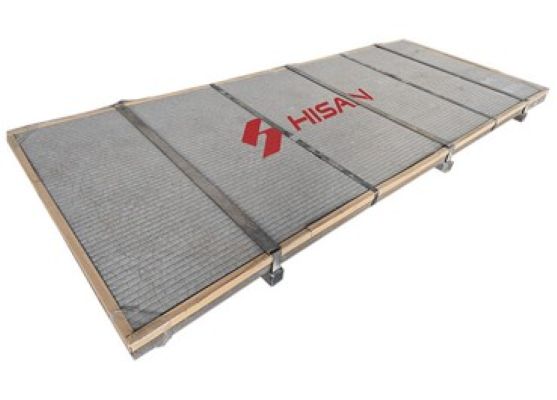
A chromium carbide overlay plate earns its reputation in the structure, not the label. HISAN manufactures its CCO plate by cladding a wear-resistant overlay onto a mild steel base plate, so a high volume of rich carbides fuses to the backing and distributes evenly through a uniform overlay thickness. The result is a bimetallic material that pairs strong wear resistance with enough ductility for forming and welding. Because the mild steel base can be welded or bolted, fabrication stays practical on site, and the overlay carries a macro-hardness of 57 to 63 HRC. That construction is why one plate family serves mining, iron and steel, cement, port, and coal-fired power operations, where transfer chutes, hoppers, liners, and pipes tend to wear out first.
ISO 9001 Quality Assurance Is Read Through Process Control
In this context, ISO 9001 is more than a phrase in a headline. For a professional chromium carbide overlay plate factory, a quality management system matters because it links raw material control, production parameters, and inspection before delivery into a single, reviewable framework. HISAN states that its products are manufactured under a strictly controlled quality management system, guided by a customer-oriented quality control process, with plates inspected before they leave the plant. ISO certificates and third-party test reports are available on request, which gives importers and project teams a documentary basis for supplier qualification instead of relying on certificate language alone.
Composition, Hardness, and Thickness Turn Carbide Quality into Proof
Cr7C3 carbide quality becomes measurable once it is expressed in composition, thickness, and hardness. HISAN's HS100 chromium carbide overlay wear plate lists a weld overlay composition of roughly 3.0 to 6.5 percent carbon and 16-30% chromium, an overlay thickness range of 2-80 mm, and a base material thickness range of 2-150 mm, at a bulk hardness of HRC 58-65. These are engineering parameters. Carbon and chromium content shape how the carbides form, thickness governs the wear allowance, and hardness gives buyers a comparable engineering value. The plates are supplied in standard sizes such as 1400 by 3000 mm and 2000 by 3000 mm, in common base-plus-overlay combinations, with other sizes and thicknesses available on request. For heavier duty, the HS200 grade extends the same logic with a higher chromium range, so specifiers can match the plate to the working condition rather than guess at it.
ASTM G65 Testing and Metallography Make Performance Easy to Audit
Hardness is solely one element of performance verification. HISAN reports abrasion performance for HS100 under ASTM G65 Procedure A, with a mass loss of no more than 0.20 grams, and pairs that figure with an X200 metallographic view of the overlay structure. Reading the two together lets a buyer cross check tested wear loss against the microstructure that produces it. That is the difference between a general claim of wear resistance and a result a procurement engineer can file, compare, and defend when a plate is specified for a mining chute or a power plant coal line.
Factory Equipment Backs Up Quality Before Shipment
Manufacturing capability must support any market-positioning claim. HISAN's testing floor includes a SPECTRO spectrometer and a portable spectrometer for composition, Vickers, desktop Rockwell, and portable hardness testers, a portable thickness tester, an ASTM G65 wear test machine, and a metallographic microscope.
Production is just as visible, with a processing workshop, plasma cutting, flattening and bending machines, a welding wire production line, pipe welding machines, and an eight-torch welding machine. Taken together, they show that the CCO plate is not a single item on a shelf but a factory-level program of cutting, forming, welding, and inspection that supports consistent delivery. HISAN can also cut plates to size and fabricate finished wear parts through cutting, forming, welding, stud attachment, assembling, and grinding, so the same quality control follows the material from raw plate to installed component.
A Grade Family Matches Quality to the Job
Quality assurance should support grade selection. HISAN's CCO range runs from HS100 and HS200 through HS300 and HS600 to the smooth-surface HS-F and the customized HS-X, giving buyers a grade-family map across severe abrasion, complex carbide alloying, low hang-up surfaces, and custom requirements. The HS-F smooth surface plate, produced without raised weld beads, suits sticky flows such as coal preparation, while HS-X answers project-specific composition needs.
Choosing across one factory's own grades keeps the Cr7C3 quality story consistent from specification to fabrication to application.
About HISAN
HISAN (Tianjin) Co., Ltd. is a high-tech manufacturer of chromium carbide overlay wear-resistant plates, overlay wear pipes, welding wires, wear parts, and related wear-resistant solutions, with experience across mining, cement, thermal power, and material handling. The company keeps its promise simple: quality control and responsive technical service are central to its operating approach, supported by a strictly controlled quality management system and a integrated wear-protection solution approach.
For chromium carbide overlay plate specifications, Cr7C3 carbide quality discussion, ISO 9001 quality-assurance review, or factory capability inquiries, visit HISAN at https://www.hisancco.com/
Quality Starts with a Verifiable Overlay Structure
A chromium carbide overlay plate earns its reputation in the structure, not the label. HISAN manufactures its CCO plate by cladding a wear-resistant overlay onto a mild steel base plate, so a high volume of rich carbides fuses to the backing and distributes evenly through a uniform overlay thickness. The result is a bimetallic material that pairs strong wear resistance with enough ductility for forming and welding. Because the mild steel base can be welded or bolted, fabrication stays practical on site, and the overlay carries a macro-hardness of 57 to 63 HRC. That construction is why one plate family serves mining, iron and steel, cement, port, and coal-fired power operations, where transfer chutes, hoppers, liners, and pipes tend to wear out first.
ISO 9001 Quality Assurance Is Read Through Process Control
In this context, ISO 9001 is more than a phrase in a headline. For a professional chromium carbide overlay plate factory, a quality management system matters because it links raw material control, production parameters, and inspection before delivery into a single, reviewable framework. HISAN states that its products are manufactured under a strictly controlled quality management system, guided by a customer-oriented quality control process, with plates inspected before they leave the plant. ISO certificates and third-party test reports are available on request, which gives importers and project teams a documentary basis for supplier qualification instead of relying on certificate language alone.
Composition, Hardness, and Thickness Turn Carbide Quality into Proof
Cr7C3 carbide quality becomes measurable once it is expressed in composition, thickness, and hardness. HISAN's HS100 chromium carbide overlay wear plate lists a weld overlay composition of roughly 3.0 to 6.5 percent carbon and 16-30% chromium, an overlay thickness range of 2-80 mm, and a base material thickness range of 2-150 mm, at a bulk hardness of HRC 58-65. These are engineering parameters. Carbon and chromium content shape how the carbides form, thickness governs the wear allowance, and hardness gives buyers a comparable engineering value. The plates are supplied in standard sizes such as 1400 by 3000 mm and 2000 by 3000 mm, in common base-plus-overlay combinations, with other sizes and thicknesses available on request. For heavier duty, the HS200 grade extends the same logic with a higher chromium range, so specifiers can match the plate to the working condition rather than guess at it.
ASTM G65 Testing and Metallography Make Performance Easy to Audit
Hardness is solely one element of performance verification. HISAN reports abrasion performance for HS100 under ASTM G65 Procedure A, with a mass loss of no more than 0.20 grams, and pairs that figure with an X200 metallographic view of the overlay structure. Reading the two together lets a buyer cross check tested wear loss against the microstructure that produces it. That is the difference between a general claim of wear resistance and a result a procurement engineer can file, compare, and defend when a plate is specified for a mining chute or a power plant coal line.
Factory Equipment Backs Up Quality Before Shipment
Manufacturing capability must support any market-positioning claim. HISAN's testing floor includes a SPECTRO spectrometer and a portable spectrometer for composition, Vickers, desktop Rockwell, and portable hardness testers, a portable thickness tester, an ASTM G65 wear test machine, and a metallographic microscope.
Production is just as visible, with a processing workshop, plasma cutting, flattening and bending machines, a welding wire production line, pipe welding machines, and an eight-torch welding machine. Taken together, they show that the CCO plate is not a single item on a shelf but a factory-level program of cutting, forming, welding, and inspection that supports consistent delivery. HISAN can also cut plates to size and fabricate finished wear parts through cutting, forming, welding, stud attachment, assembling, and grinding, so the same quality control follows the material from raw plate to installed component.
A Grade Family Matches Quality to the Job
Quality assurance should support grade selection. HISAN's CCO range runs from HS100 and HS200 through HS300 and HS600 to the smooth-surface HS-F and the customized HS-X, giving buyers a grade-family map across severe abrasion, complex carbide alloying, low hang-up surfaces, and custom requirements. The HS-F smooth surface plate, produced without raised weld beads, suits sticky flows such as coal preparation, while HS-X answers project-specific composition needs.
Choosing across one factory's own grades keeps the Cr7C3 quality story consistent from specification to fabrication to application.
About HISAN
HISAN (Tianjin) Co., Ltd. is a high-tech manufacturer of chromium carbide overlay wear-resistant plates, overlay wear pipes, welding wires, wear parts, and related wear-resistant solutions, with experience across mining, cement, thermal power, and material handling. The company keeps its promise simple: quality control and responsive technical service are central to its operating approach, supported by a strictly controlled quality management system and a integrated wear-protection solution approach.
For chromium carbide overlay plate specifications, Cr7C3 carbide quality discussion, ISO 9001 quality-assurance review, or factory capability inquiries, visit HISAN at https://www.hisancco.com/
HISAN (TIANJIN) CO.,LTD.
HISAN
+ +86 22 84776558
email us here
Visit us on social media:
LinkedIn
YouTube
Legal Disclaimer:
EIN Presswire provides this news content "as is" without warranty of any kind. We do not accept any responsibility or liability for the accuracy, content, images, videos, licenses, completeness, legality, or reliability of the information contained in this article. If you have any complaints or copyright issues related to this article, kindly contact the author above.

