JIEPAI HOME as a China Leading Stainless Steel Sink Manufacturer: Incoming Inspection and Outgoing Quality Checks
YIWU, ZHEJIANG, CHINA, October 26, 2026 /EINPresswire.com/ -- Evaluating manufacturing rigor in commercial stainless steel sinks requires auditing factory quality control gates from raw coil uncoiling to final packaging. Sourcing directors reviewing JIEPAI HOME as a China Leading Stainless Steel Sink Manufacturer focus on metallurgical integrity, automated welding precision, and comprehensive pressure testing. Commercial kitchen projects demand dependable durability, acoustic dampening, and consistent dimensional accuracy across high-volume container deliveries. Sourcing through an established manufacturing partner provides access to certified materials, standardized production checkpoints, and traceable quality documentation that protect overseas distribution networks. Establishing disciplined quality protocols from initial stamping through finished packaging eliminates structural defects, reduces field warranty claims, and preserves commercial brand reputations.
How a Stainless Steel Sink Manufacturer Builds Three-Stage Quality Control
A commercial stainless steel sink quality assurance protocol requires three sequential testing gates: raw master coil spectrometry, robotic seam welding monitoring, and finished pneumatic leak testing. Audited under ASME A112.19.3 and NSF/ANSI Standard 2, multi-stage inspection eliminates stress corrosion cracking and guarantees sanitary compliance across volume shipments. Factory receiving gates mandate optical emission spectrometry on every master coil lot to verify SUS304 chemical composition, confirming a minimum of eight percent nickel and eighteen percent chromium content. Ultrasonic thickness gauges scan strip profiles to maintain raw sheet thickness within a tight tolerance of plus or minus 0.03 mm.
Mechanical tensile tests verify elongation properties, ensuring that cold-rolled sheet lots withstand severe hydraulic press deformation without localized necking. Material test certificates are cataloged by coil heat number, establishing material traceability before stainless sheets enter the blanking line. While Type 304 stainless steel offers exceptional durability, it remains vulnerable to pitting corrosion when exposed to stagnant chloride concentrations above 50 parts per million. Routine freshwater rinsing after chemical sanitization preserves the passive chromium oxide barrier in high-volume foodservice operations.
Incoming Inspection Starts with the Material and Model Requirement
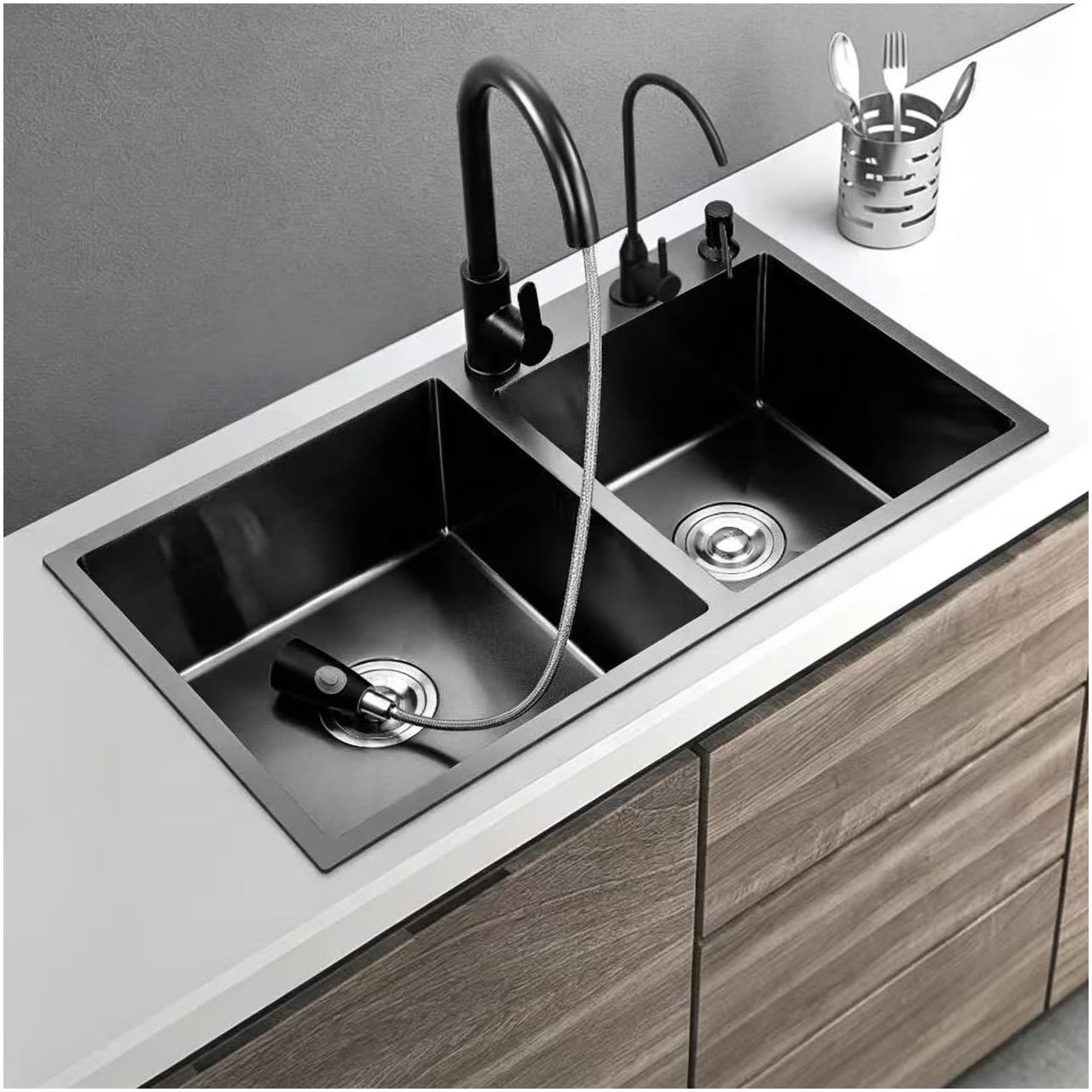
Fabricating commercial multi-compartment stainless steel sinks illustrates how automated tooling controls dimensional repeatability across high-volume production. Welded dual-basin units require continuous press forming and automated partition welding under an inert shielding gas blanket. Precision robotic weld paths prevent atmospheric oxidation and slag porosity, producing high-integrity fusion joints that endure heavy localized impacts and thermal cycling.
In-line quality monitors verify seam penetration through periodic liquid dye penetrant inspections, confirming complete absence of micro-fissures along basin corners. Robotic edge-brushing wheels then dress internal fillet radii to a smooth, uniform surface that prevents grease entrapment and simplifies food sanitation.
Pneumatic applicators stamp dense EVA sound-deadening pads onto bottom and side walls, verified through peel-adhesion pull tests exceeding 25 Newtons per centimeter. Automated spray heads apply an anti-condensation undercoating with a controlled dry film thickness of 1.2 to 1.5 mm, preventing cabinet rot caused by temperature differentials.
In-Production Monitoring Keeps Manufacturing Details Aligned
Finished goods checks establish baseline mechanical compliance prior to master carton packing. Outgoing inspection stations test one hundred percent of sink drains and seam junctions under 0.03 MPa pneumatic air-decay pressure. This fifteen-second test detects microscopic leak paths that escape visual observation.
Laser-calibrated coordinate measuring arms check diagonal rim squareness, verifying that perimeter mounting flanges remain flat within 0.8 mm across an 800 mm length on precision granite inspection tables. Water-drainage slope tests confirm rapid evacuation without standing water puddles in basin corners.
Packaging line auditors verify barcode labeling, corner foam density, and installation clip quantities, ensuring complete hardware kits accompany every palletized shipment.
Outgoing Checks Close the Quality-Control Loop Before Shipment
Structured quality gates enable commercial buyers to order standard models or develop proprietary tooling configurations with predictable lead times. Sourcing teams can modify basin depths, specify custom drain hole positions, or request laser-etched private-label logos. Factory engineers issue formal Inspection and Test Plans defining specific acceptance criteria before cutting prototype stamping dies.
This technical clarity accelerates pre-shipment container sign-offs and prevents commercial disputes over cosmetic blemishes or dimensional mismatches.
Different Sink Models Need Model-Specific Inspection Priorities
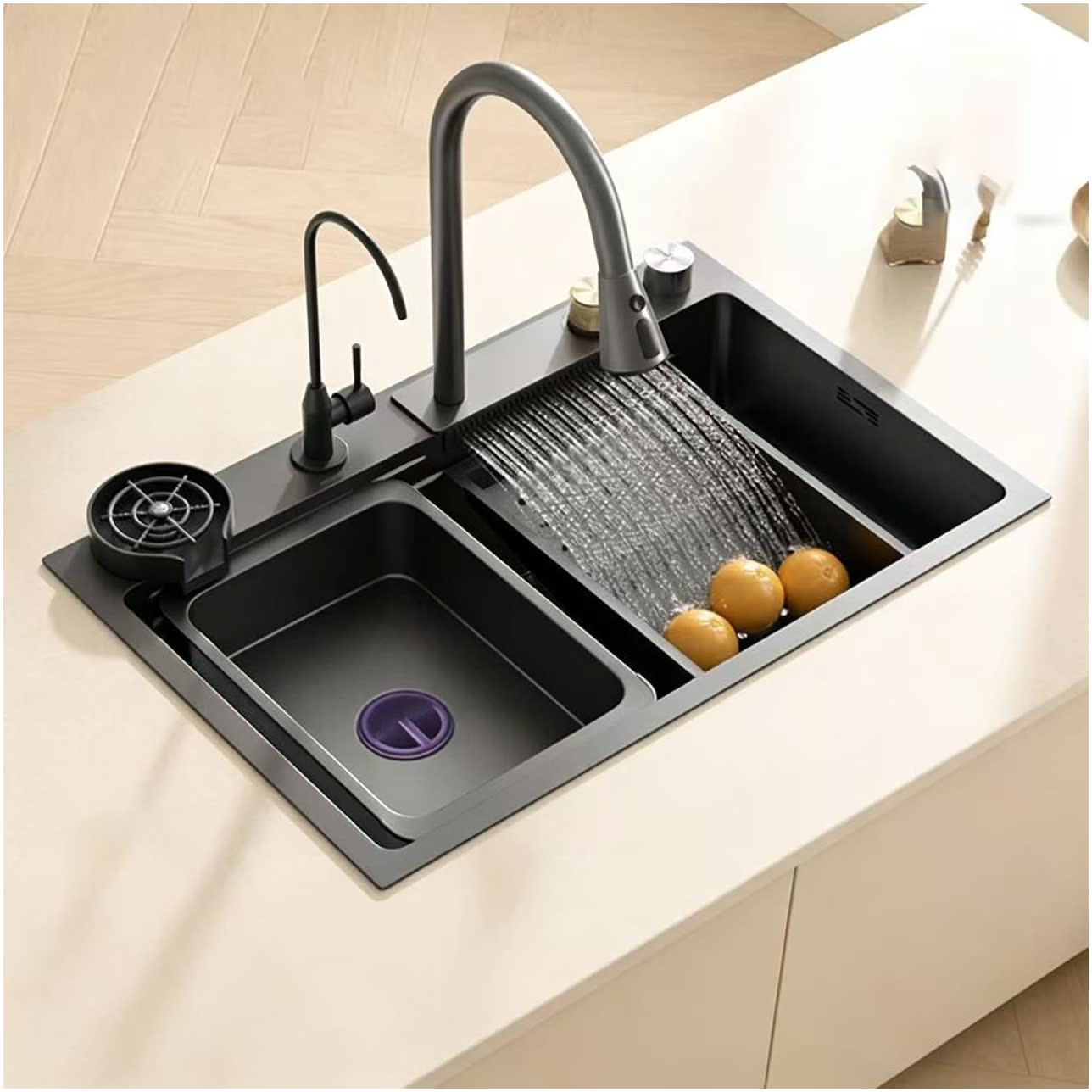
Quality control criteria must reflect the mechanical differences between specific sink designs rather than applying generic inspection checklists. Stamped dual-basin units and handmade single-basin sinks present distinct fabrication challenges that require specialized inspection points.
Single-piece deep-drawn basins and fabricated multi-compartment commercial sinks present distinct engineering challenges that require specialized inspection points. Deep-drawn sinks require stringent incoming metallurgical drawability checks, ultrasonic corner wall-thinning audits, and automated rim flatness scanning. Fabricated multi-basin sinks demand non-destructive dye penetrant weld inspection, central divider weld seam alignment, and pneumatic bubble leak testing along fabricated joints. Both formats require dedicated dimensional gauging, verifying that rim squareness and undermount clip interfaces match architectural submittal drawings.
When scaling from sample approval to bulk container production, maintaining model-specific inspection protocols prevents operational drift. Buyers who lock physical dimensions, welding methods, and finishing tolerances in technical spec sheets enable factory quality teams to execute repeatable, auditable quality checks.
Frequently Asked Questions about Stainless Steel Sink Quality Control
What Is the Purpose of Incoming Inspection for a Stainless Steel Sink Order?
Incoming inspection validates sheet thickness, alloy composition, and surface uniformity before production starts, preventing sub-gauge steel or defective coils from entering stamping lines.
How Is In-Production Monitoring Different from the Outgoing Check?
In-production monitoring tracks active welding parameters, seam alignment, and surface polishing during fabrication, whereas outgoing checks audit finished product dimensions, drainage fitment, and export packaging prior to shipment.
Why Should Sink Dimensions Stay Tied to a Specific Model?
Dimensions govern countertop cutouts, basin water volumes, and under-counter plumbing clearances. Single-piece deep-drawn basins and fabricated multi-compartment sinks represent distinct architectural footprints that cannot share generic tolerances. Locking exact exterior dimensions, basin depths, and drain locations in production tooling drawings ensures seamless countertop fabrication and prevents costly field installation mismatches.
How Can a Sample Support a Bulk Sink Order?
A pre-production sample provides an approved physical benchmark for sheet gauge, weld seam finishing, and dimensional tolerances, against which container-scale production lots are formally audited.
What Should Procurement Teams Include in the Initial Sink Inquiry?
Inquiries should specify target outer dimensions, bowl configuration (single or double), stainless steel thickness, preferred welding method, quantity, customization requirements, and sample delivery requirements.
Move from Sink Specifications to a JIEPAI HOME Sourcing Discussion
Rigorous quality control workflows protect commercial sink distributors from costly field warranty failures and installation delays. Establishing transparent metallurgical verification and automated seam inspection ensures consistent dimensional accuracy across volume shipments.
Procurement directors and quality auditors can submit project specifications through the JIEPAI HOME storefront to obtain factory Inspection and Test Plans, Material Test Reports, and initial inspection samples.
JIEPAI HOME
JIEPAI HOME
Legal Disclaimer:
EIN Presswire provides this news content "as is" without warranty of any kind. We do not accept any responsibility or liability for the accuracy, content, images, videos, licenses, completeness, legality, or reliability of the information contained in this article. If you have any complaints or copyright issues related to this article, kindly contact the author above.